Linear Ordinary Differential Equation, ODE #
$$ a_n x^{(n)} + a_{n-1} x^{(n-1)} + \dots + a_1 x^{(1)} + a_0 x = g(t) $$$x^{(n)}$: x’s n th derivative for t
$g(t)$: Forcing Term, if $g(t)\neq 0$, then this ODE is a Non-Homogeneous Function
Complementary Function #
If $g(t)$ is zero, in which the ODE is a Homogeneous Function, then the function is aka Complementary Function
$$ a_n x^{(n)} + a_{n-1} x^{(n-1)} + \dots + a_1 x^{(1)} + a_0 x = 0 $$It describe the behavior of function when no outer influence
Whereas the solution to this function is then called the Complementary Solution $x_c(t)$
$$ x_c(t) = C_1 x_1(t) + C_2 x_2(t) + \dots + C_n x_n(t) $$The Complementary Solution is the n th solution’s Linear Combination
Whereas the Coefficient C is determined by the Initial Conditions
Particular Solution #
The solution satisfied when $g(t)\neq 0$
The Particular Solution can be solved using Superposition, that is analysis two terms of $g(t)$ individually and add up later
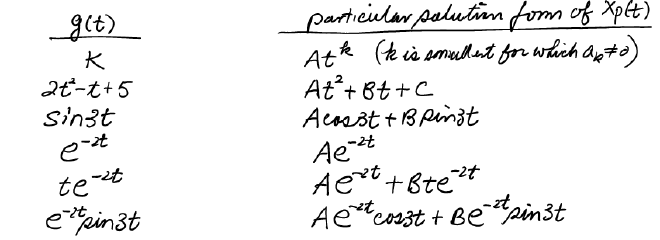
Pick solution for particular type of g(t) #
Ex. Finding Coefficient for Particular Solution #
Suppose having function $x'' - 2x' + 3x = 3t^2 + 2t$
Based on the table, we guess the solution is in the form of $x_p(t) = At^2 + Bt + C$, this solution has the first derivative as $2At+B$ and second derivative as $2A$, thus
$$ (2A) - 2(2At + B) + 3(At^2 + Bt + C) = 3t^2 + 2t $$Arrange LHS and we can get $x_p(t) = t^2 + 2t + \frac{2}{3}$
Exception for Particular Solution #
If the assumed Particular Solution has already been mentioned in Complementary solution, then we need to time the guess to a $t^k$ (k normally = 1) until it’s not equal to Complementary solution
General Solution #
$$ x(t) = x_c(t) + x_p(t) $$First-order homogeneous ODE #
A Particular ODE in the form of
$$ ax' + bx = 0 $$This function is being solved by the characteristic function, by letting $x(t) =e^{st}$
$$ a(se^{st}) + b(e^{st}) = 0\Rightarrow as + b = 0 $$First-order RC/RL circuits #
RC Circuit #
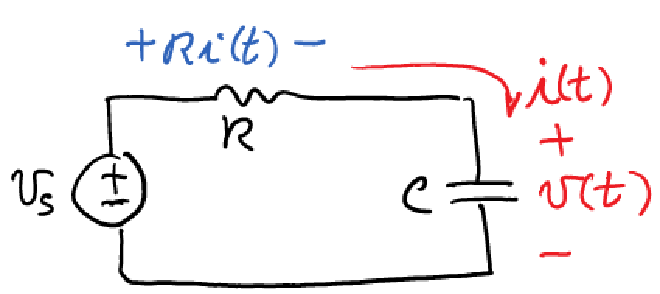
Starting with the KVL, we get $R \cdot i(t) + v(t) = v_s(t)$, then known the relationship between Capacitor and current $i(t) = C \frac{dv(t)}{dt}$, sub in this to get the Differential Equation
$$ RC \frac{dv(t)}{dt} + v(t) = v_s(t) $$RL Circuit #
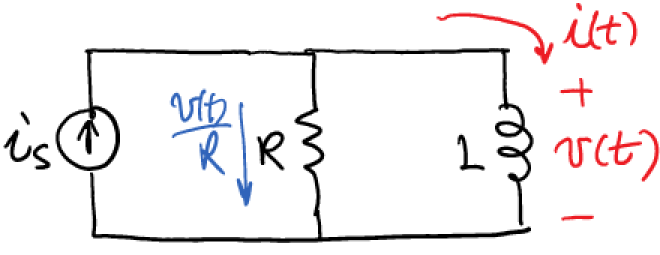
In RL Circuit we use KVL instead to get $\frac{v(t)}{R} + i(t) = i_s(t)$, knowing the relation between Inductor’s Voltage and Current to get
$$ \frac{L}{R} \frac{di(t)}{dt} + i(t) = i_s(t) $$Those two RC and RL Circuit are just 1st Order Non-Homogenous ODE
Now we can first analysis the case when it’s Homogenous to find complementary solution
RC circuit zero input response #
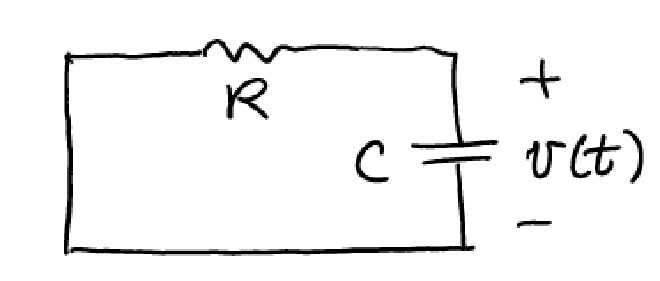
When the outer battery has been removed, the equation is now
$$ RC v'(t) + v(t) = 0 $$With the Initial Condition that $v_c=0$, we can get the solution which is
$$ v(t) = V_0 e^{-t/RC} \quad (t \ge 0) $$Notice that there’s a Coefficient $RC$ shifting the response rate of circuit which is $\tau = RC$
A key point is when $t=\tau$, $v_o$ will goes to 0.37 $v_0$ at this stage
RC circuit step response #
Now going back to case when the external Voltage Source exist, as we want to analysis a source which only occur then $t>0$, thus we will need a Unit Step Function $u(t)$
$$ RCv'(t) + v(t) = V_s u(t) $$And this equation will have the solution of $v(t) = v_c(t) + v_p(t)$, where $v_c$ is the Natural Response, and $v_p$ is $v_f$, the Force Response
- Natural Response $v_n$: Has the form of $v_n(t) = K e^{-t/RC}$
- Forced Response $v_f$: As $t\rightarrow \infty$, the particular solution will then be $V_s$
Thus the general solution will then be
$$ v(t) = K e^{-t/RC} + V_s $$This K is just the coefficient C in ODE, that can be determined by sub in $v(0) =v_0$, so we get
$$ v(t) = (V_0 - V_s)e^{-t/RC} + V_s $$Different Interpertations #
We can treat this Reaction in two different perspectives
Natural + Forced #
$$ v(t) = \underbrace{V_0 e^{-t/\tau}}_{\text{Zero-Input (ZIR)}} + \underbrace{V_s(1 - e^{-t/\tau})}_{\text{Zero-State (ZSR)}} $$This form is more like a mathematic interpretation, that this is Complementary + Particular
Zero Input + Zero State #
$$ v(t) = \underbrace{V_0 e^{-t/\tau}}_{\text{Zero-Input (ZIR)}} + \underbrace{V_s(1 - e^{-t/\tau})}_{\text{Zero-State (ZSR)}} $$Describe the Capacitor under Initial Condition and Outer Input Source
We can conclude this RC Circuit by one formula
$$ v(t) = (v_{\text{initial}} - v_{\text{final}}) e^{-t/\tau} + v_{\text{final}} $$Response to exponential input #
Now that $g(t)$ has become a exponential function
$$ RC v'(t) + v(t) = V_s e^{-\alpha t} $$Solving this by Complementary + Particular can get
$$ v(t) = \left( V_0 - \frac{V_s}{1 - \alpha RC} \right) e^{-t/RC} + \frac{V_s}{1 - \alpha RC} e^{-\alpha t} $$

A special case is given by when $\alpha =1/RC$m this can be solved by timing a t at Forced Response, that is
$$ v(t) = V_0 e^{-t/RC} + \frac{V_s}{RC} t e^{-t/RC} $$2nd-Order DE #
The standard 2nd Order DE formula is given by
$$ ax'' + bx' + cx = 0 \quad (a \neq 0) $$This equation can also be solved by using the Characteristic Equation
$$ as^2 + bs + c = 0 $$Known that this equation will have the solution of $(s_1, s_2) = \frac{-b \pm \sqrt{b^2 - 4ac}}{2a}$
There will be several different kind of solutions based on the Sign of $D = b^2 - 4ac$
Case 1: Over-damped #
Two District Real Roots: $b^2 - 4ac > 0$, having the General Solution of
$$ x(t) = c_1 e^{-\alpha_1 t} + c_2 e^{-\alpha_2 t} $$This means that the Damp is high that the System won’t Oscillate, and it will goes to equilibrium
Case 2: Critically Damped #
Two Identical Real Roots: $b^2 - 4ac = 0$, having General Solution of
$$ x(t) = c_1 e^{-\alpha t} + c_2 t e^{-\alpha t} $$The fastest condition for system to go back to equilibrium
Case 3: Underdamped #
One Conjugated Complex Roots: $b^2 - 4ac < 0$, having General Solution of
$$ x(t) = c_1 e^{-\alpha t} \cos(\beta t) + c_2 e^{-\alpha t} \sin(\beta t) $$The system will Oscillate and then goes to Equilibrium
Series RLC Circuit #
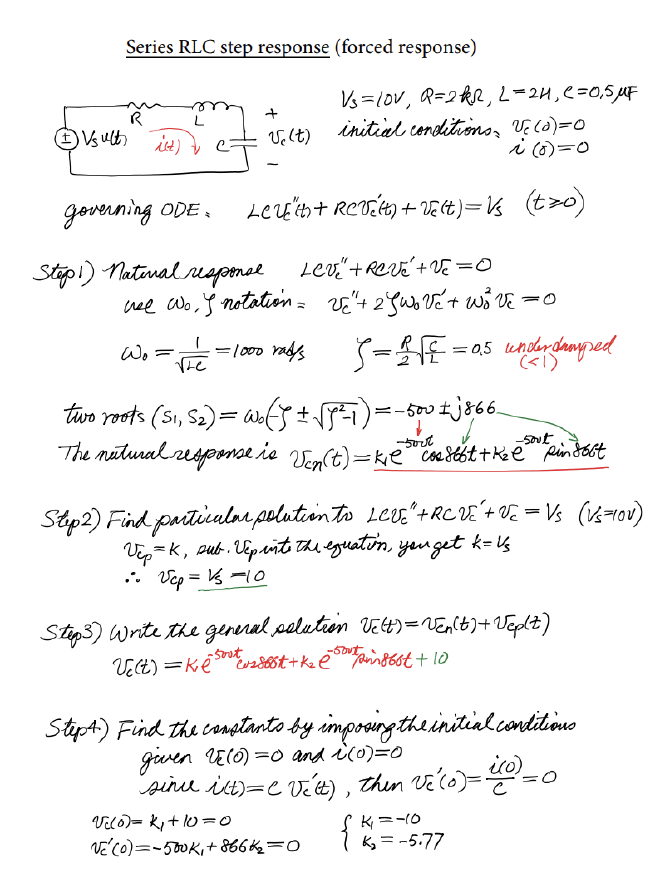
Now we can use the 2nd Order DE to analysis the Series RLC Circuit
Known the KVL is $v_L(t) + v_R(t) + v_C(t) = V_s(t)$
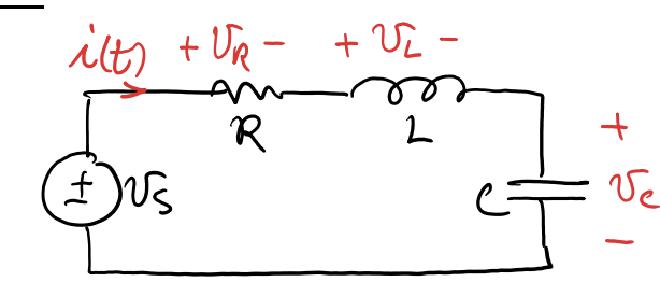
There’s 3 Circuit Element in the RLC Circuit, and we can analyse their voltage one by one
- Firstly we know in this series Circuit the current is $i = C \frac{dv_c}{dt}$
- Inductor: $v_L = L \frac{di}{dt}$, as $i = C \frac{dv_c}{dt}$, we have $v_L = LC v_c''$
- Resistor: $v_R = Ri = RC v_c'$
Then add up everything to get
$$ LC v_c''(t) + RC v_c'(t) + v_c(t) = V_s(t) $$Process of Solving #
Find the Complementary Solution #
Letting Force to be zero
$$ LC v_c'' + RC v_c' + v_c = 0 $$This have the characteristic equation of
$$ as^2 + bs + c = 0 $$Find the Particular Solution #
A Forced Solution when $V_s\neq 0$
Use the Initial Condition #
Use the Initial Condition to find the coefficient
Ex. Zero-Input Response #
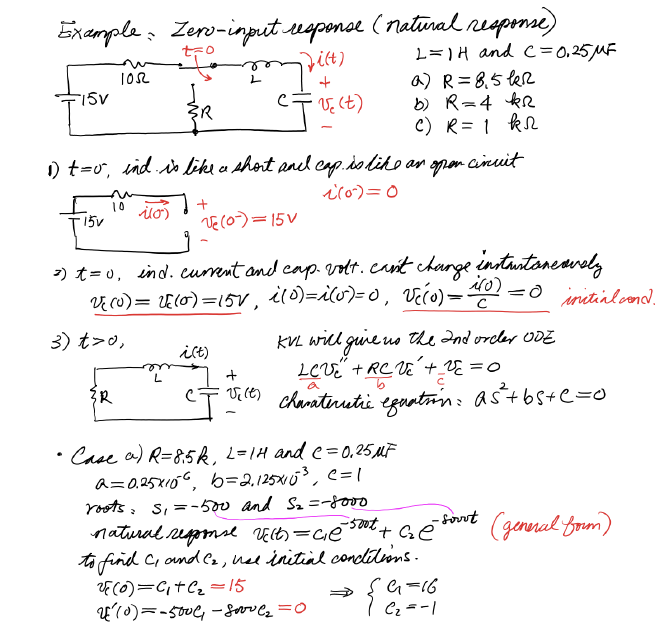
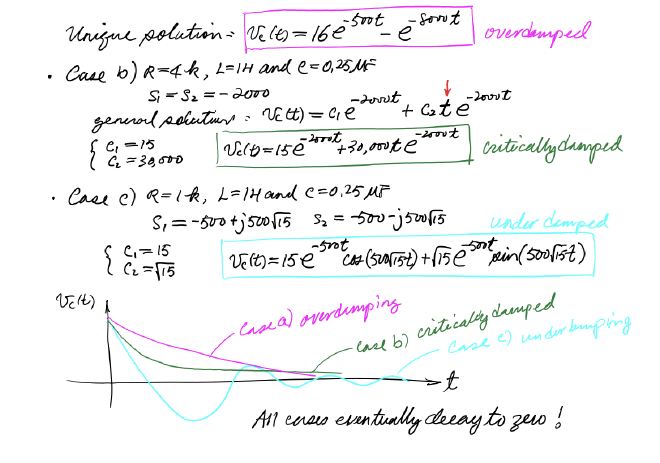
The Zeta and Omega Notation #
From above we known that the Homogeneous ODE is
$$ ax'' + bx' + cx = 0 $$Now we substitute $\omega_0^2=\frac{c}{a}$ and $\zeta = \frac{b}{2\sqrt{ac}}$, we can get
$$ x'' + 2\zeta\omega_0 x' + \omega_0^2 x = 0 $$As the a,b,c coefficient only represent the Physical Quantity, it doesn’t tells us about the system’s status, thus we introduce Zeta and Omega, whereas
- Zeta is the Phase
- Omega is the Speed
So now we can describe the system as
| State | Condition | Nature of Roots | Phenomenon Description |
|---|---|---|---|
| Overdamped | $\zeta > 1$ | Two distinct negative real roots | The system returns slowly to the equilibrium position without any oscillation. |
| Critically Damped | $\zeta = 1$ | Two equal negative real roots | The system returns to the equilibrium position in the shortest possible time without oscillation. |
| Underdamped | $\zeta < 1$ | A pair of complex conjugate roots | The system oscillates around the equilibrium position, but the amplitude gradually decays over time. |
Now we can sub in the RLC to get $\omega_0 = \frac{1}{\sqrt{LC}}$, and $\zeta = \frac{R}{2}\sqrt{\frac{C}{L}}$
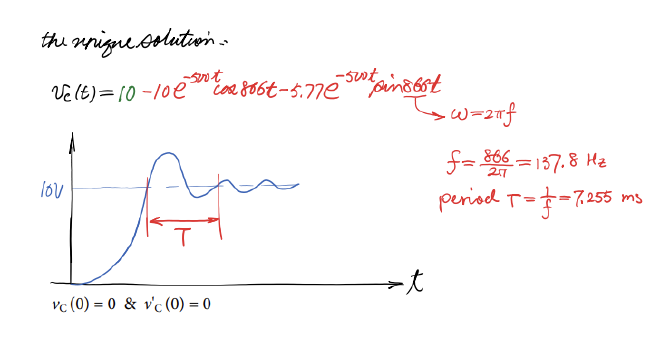
Ex. Series RLC Step Response #