EF 3. Gauss' Law Edited
Last Edit: 3/28/25
Electric Flux #
- 穿一个大小为 A 的平面的 Electric Field 个数
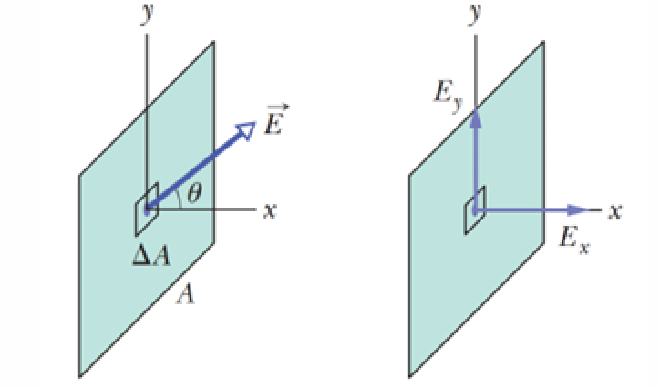
$$ \Delta \Phi = (E \cos \theta) \Delta A $$
- 也可以替换为 Dot Product,$\Delta \Phi = \vec E \cdot \Delta A$,同样的,Total Flux就是
$$ \Phi=\sum \vec E\cdot \Delta \vec A,or~\Phi=\int\vec E\cdot d\vec A $$
ex. #
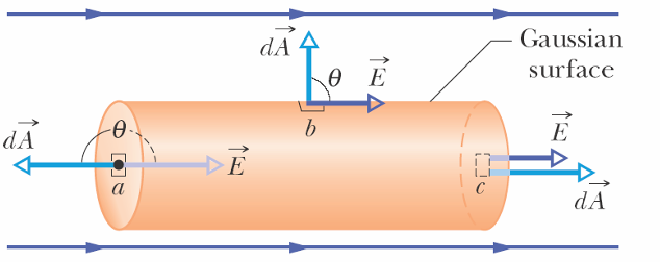
Consider a cylinder of radius R in a uniform electric field with axis parallel to the field direction, what are the flux through the end caps, cylindrical surface, and the net flux?

Gauss’s Law #
- Consider a particle with charge +q is surrounded by an imaginary concentric sphere

这是一个 Gauss‘ Law 的 Special Case
$$ \Phi = \oint \vec{E} \cdot d\vec{A} = \oint E , dA = E \oint dA= E \cdot 4\pi r^2 = \left( \frac{1}{4 \pi \varepsilon_0} \cdot \frac{q}{r^2} \right) \cdot 4 \pi r^2 = \frac{q}{\varepsilon_0} $$
- 其中 $\oint dA$ 指的是一个封闭曲面的总面积
- 通过上面等式,Gauss’ Law 说明了一个闭合表面即 Gaussian Surface 的 Electric Flux 和其包围的 Net Charge 的关系,即
$$ {\varepsilon_0}\Phi = Q_{\text{enc}} $$
ex. Gauss’s Law #
Consider two charges with opposite signs and equal magnitude (+q and –q). Determine the electric flux of the four Gaussian surfaces are shown below:

- S1:q 是一个 Positive Charge,是一个 Positive Number
- S2:q 是一个 Negative Charge,是 Negative
- S3:其所围成的空间中并不包含 Charge,所以 Zero
- S4:Net charge 为 0,即 Zero
A charged Isolated Conductor #
- 孤立导体上,所有额外的电荷都会移动到导体的表面,导体内部不会有多余电荷
- 这是因为导体内部的电荷会通过相互作用重新分布,直到内部电场为零,从而达到静电平衡

- 同理如果里面出现了一个 Cavity,其也不会存在电荷
- 当 Conductor 不是一个光滑的 Spherical 的情况下,电荷并不会均匀的分布在表面上,而是受到曲率的影响,导致尖锐的部分会拥有更多的电荷密度
The External Electric Field #

- 对于一个贴着 Conductor 的 Gaussian Surface,由于 Conductor 内部 Electric Field 为 0,所以只考虑外部的通量
$$ ε₀EA = σA $$
- 导体表面外侧的电场强度等于表面电荷密度除以 $\varepsilon_0$,但这个关系只在表面成立
Applying Gauss’s Law: Cylindrical Symmetry #
- 有一个长度为无线的 Plastic Rod,其 Charge Density 为 \lambda
- 想求离Central Axis的半径为r的距离处的Electric Field Magnitude
- 由于Electric Field是从圆柱体中心穿过的,而有Gauss’ Law
$$ \Phi = \frac{Q_{\text{enc}}}{\epsilon_0}= \oint \vec{E} \cdot d\vec{A} $$
- 可以得出面积等于 $A = 2\pi rl$
- 已知电荷密度为 $\lambda$,即总电荷数为 $Q_{enclosed}=\lambda \cdot L$,所以有 $2\pi rl E=\frac{\lambda L}{E_0}$,也就是
$$ E = \frac{\lambda}{2\pi\epsilon_0 r} $$
ex. Lighting strikes the tree #
当雷电击中一棵树的时候,其可以被看作是一个导线,而半径为r内的空气都将被 Ionized,计算出这个半径r,令 E=3\times 10^6 N/C
$$ r = \frac{\lambda}{2\pi\epsilon_0 E}= \frac{1 \times 10^{-3}\ \text{C/m}}{(2\pi)(8.85 \times 10^{-12}\ \text{C}^2/\text{N}\cdot\text{m}^2)(3 \times 10^6\ \text{N/C})}= 6\ \text{m} $$
Applying Gauss’s Law: Planar Symmetry #
- 对于一个无限大的电荷密度为 $\sigma$ 的Plane,有 $\sigma=\frac{Q}{A}$
- 根据 Gauss’ Law $\Phi = \frac{Q_{\text{enc}}}{\varepsilon_0}$,其中 $Q=\sigma A$,于是有
$$ \Phi=\frac{\sigma A_0}{\varepsilon_0} $$
- 令其中一个 Cylinder 为高斯面,Flux 从两个Cross-Sectional Area 流过
$$ \Phi=EA=2EA_0=\frac{\sigma A_0}{\varepsilon_0} \Rightarrow E=\frac{\sigma}{2\varepsilon_0} $$
Applying Gauss’s Law Shell Theorem #1 #
- 回顾 Shell Theorem #1,它讲的是一个带有均匀电荷的壳层对壳外的粒子的吸引或排斥作用,就像所有电荷集中在球壳的中心一样
$$ \Phi = \oint \vec{E} \cdot d\vec{A} = E \oint dA = E \cdot 4\pi r^2 \\varepsilon_0 \Phi = q_{\text{enc}} \quad \text{(where } \varepsilon_0 \text{ is the permittivity of free space)} \\varepsilon_0 E \cdot 4\pi r^2 = q_{\text{enc}}\Rightarrow E = \frac{1}{4\pi \varepsilon_0} \cdot \frac{q_{\text{enc}}}{r^2} $$
Applying Gauss’s Law Shell Theorem #2 #
- 第二个 Shell Theorem 说的是如果一个带电粒子处于一个带有均匀电荷分布的壳层内部,那么壳层对该粒子不会产生任何 Electrostatic force
- 这是因为所有的电荷都在 Shell 的 surface 上,内部 Gauss Surface 所包围的 Charge 为 0,所以内部粒子不会受到任何 Electrostatic Force
However, there can still be an electric field within the shell, created by other objects
需要注意的是,Shell 内部仍可能存在其他物体所产生的电场
Applying Gauss’ Law: Spherical Symmetry #
- 有一个球壳,上面的Charge均匀分布,电荷总量为q,半径为R
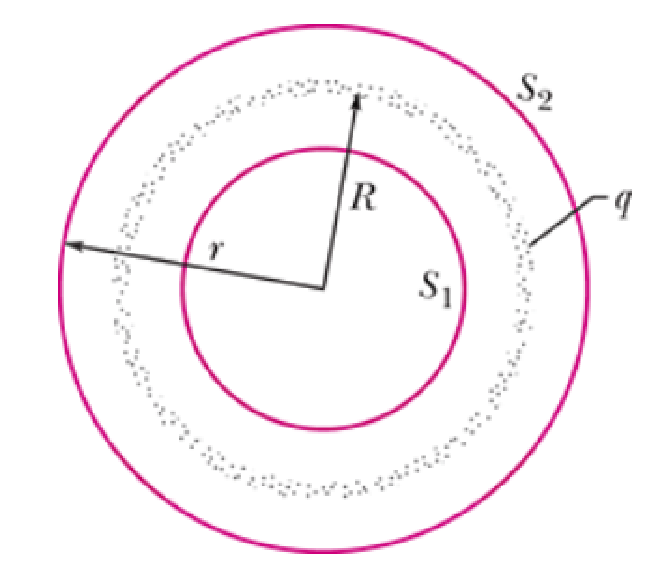
- 使用两个同心的球形高斯面 $S_1$ 和 $S_2$
- 对于内部高斯面 $S_1$ 来说,Electric Field 为 0,Electric Flux 也为 0
- 对于外部高斯面 $S_2$ 来说,Electric Field公式由 $E=\frac{q}{4\pi\varepsilon_0r^2}$ 给出,由 Shell Theorem 1 证明,球壳外部的 Charge 可以被视为 Point Charge
- 第二种情况则是一个带电的均匀实心球体(电荷在其中均匀分布)
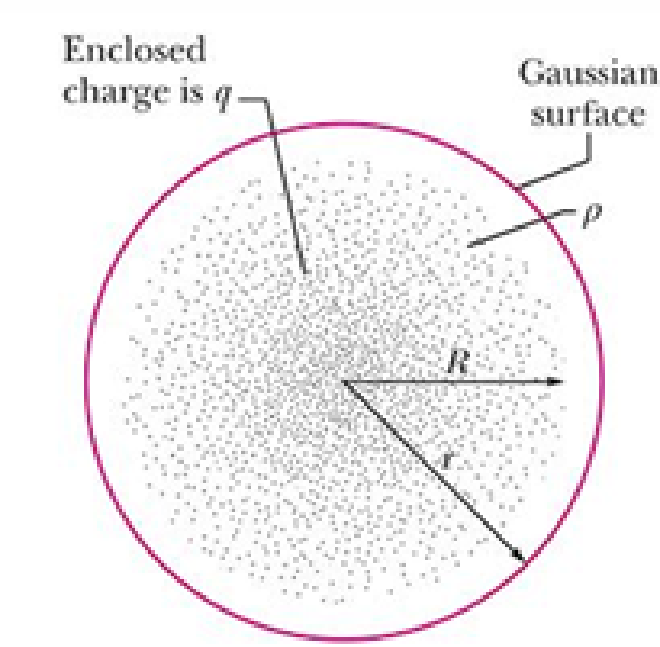
- 令整个实心球半径为R,总电荷量为q,且在体积内均匀分布,则体积电荷密度
$$ \rho ;=; \frac{q}{\tfrac{4}{3}\pi R^3} $$
- 在球内取一半径为 $r<R$ 的球面作高斯面,则该高斯面所包围的电荷量
$$ Q_{\text{enclosed}} ;=; \rho \times \bigl(\tfrac{4}{3}\pi r^3\bigr) = \frac{q}{\tfrac{4}{3}\pi R^3};\times;\tfrac{4}{3}\pi r^3 = q,\frac{r^3}{R^3} $$
- 由对称性,球面上电场大小恒为E,方向辐向向外,故
$$ \oint \mathbf{E}\cdot \mathrm{d}\mathbf{A} = E,\cdot 4\pi r^2 $$
- 高斯定律给出
$$ E \cdot 4\pi r^2 = \frac{Q_{\text{enclosed}}}{\varepsilon_0} = \frac{q,\tfrac{r^3}{R^3}}{\varepsilon_0} \Rightarrow E(r) = \frac{1}{4\pi \varepsilon_0} ,\frac{q,\tfrac{r^3}{R^3}}{r^2} = \frac{1}{4\pi \varepsilon_0},\frac{q}{R^3},r $$
- 总的来说空心球壳:
- 壳外 $r \ge R$:电场如点电荷,$E=\frac{1}{4\pi\varepsilon_0},\frac{q}{r^2}$
- 壳内 $r \le R$:电场为 0
- 实心均匀带电球:
- 球外 $r \ge R$:同样表现为点电荷,$E=\frac{1}{4\pi\varepsilon_0},\frac{q}{r^2}$
- 球内 $r \le R$:$E=\frac{1}{4\pi \varepsilon_0},\frac{q}{R^3},r$,即随r线性增大