D2L 4.4 Model Selection, Underfitting, and Overfitting
深度学习的目的是发现Pattern,即做到模型的Generalization 泛化
- [[Overfitting Problem]]
原因很简单:当我们将来部署该模型时,模型需要判断从未见过的患者。 只有当模型真正发现了一种泛化模式时,才会作出有效的预测
困难在于,当我们训练模型时,我们只能访问数据中的小部分样本。 最大的公开图像数据集包含大约一百万张图像。 而在大部分时候,我们只能从数千或数万个数据样本中学习。 在大型医院系统中,我们可能会访问数十万份医疗记录。 当我们使用有限的样本时,可能会遇到这样的问题: 当收集到更多的数据时,会发现之前找到的明显关系并不成立。
Overfitting 过拟合 #
- 模型在训练数据上拟合的比在潜在分布中更接近的现象称为过拟合
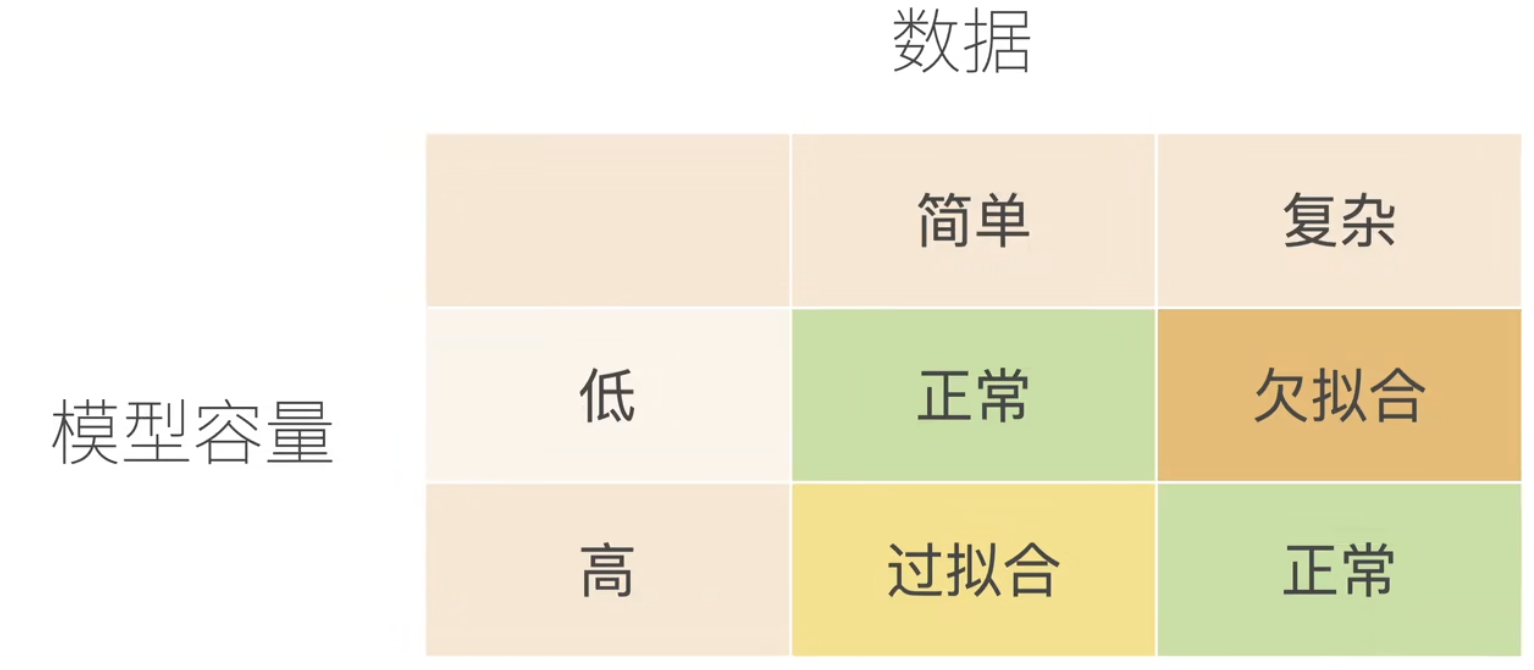
- 左: Underfitting 欠拟合
- 中:拟合
- 右:Overfitting 过拟合
Regularization 正则化 #
- 对抗过拟合的技术称为正则化
- [[Regularization 正则化]]
4.4.1 训练误差和泛化误差 #
Training Error 训练误差 #
- 模型在训练数据集上计算得到的误差
Generalization Error 泛化误差 #
- 同样分布样本的无限多个数据的模型误差期望
- 但问题是对于无限多个数据,我们不可能准确的计算出Genrelization Errorz
4.4.1.1 统计学习理论 #
- 我们假设训练数据和测试数据都是从相同的分布中独立提取的。 这通常被称为_独立同分布假设_(i.i.d. assumption)
4.4.1.2 模型复杂性 #
- 一个模型的复杂性取决于很多因素
- 如模型参数,取值范围
Early Stopping 早停 #
- 早停(Early Stopping):这是一种防止过拟合的技术,其中训练过程在验证集上的性能开始恶化时停止。这意味着,如果模型在验证集上的误差开始增加,表明模型可能开始过拟合训练数据,此时停止进一步训练可以避免这种情况。
4.4.2 模型选择 #
- 在一个训练中,我们会选择几个候选模型对他们进行评估
4.4.2.1 验证集 #
- 总的来说,对于Superivised Training,一般讲整体划为3个区块
Training Set 训练集 #
- 训练集用来训练模型,即确定模型的权重和偏置这些参数,通常我们称这些参数为学习参数
- 训练集中的参数直接参与到梯度下降中
Validation Set 验证集 #
z
- 而验证集用于模型的选择,更具体地来说,验证集并不参与学习参数的确定,也就是验证集并没有参与梯度下降的过程
- 验证集只是为了选择超参数,比如网络层数、网络节点数、迭代次数、学习率这些都叫超参数
Test Set 测试集 #
- 测试集只使用一次,即在训练完成后评价最终的模型时使用。它既不参与学习参数过程,也不参数超参数选择过程,而仅仅使用于模型的评价
4.4.2.2 K-Fold Cross-Validation K折交叉验证 #
- 训练数据稀缺时,我们甚至可能无法提供足够的数据来构成一个合适的验证集
过程描述 #
- 数据分组:首先,整个数据集被随机分成K个大小大致相同的子集。
- 迭代训练与验证:每次迭代中,选择其中一个子集作为验证集,而其余的K-1个子集合并作为训练集。
- 性能评估:模型在训练集上训练,并在验证集上进行评估。这个过程重复K次,每次选择不同的子集作为验证集。
- 平均性能:最终模型的性能是所有K次迭代中验证性能的平均值。这样可以更全面地评估模型的性能。
4.4.3 欠拟合还是过拟合? #
- Generlization Error高的模型叫做Underfitting
- Train Error远低于Validation Error的模型叫做Overfitting
4.4.3.1 模型复杂性 #
![[Pasted image 20240615153938.png]]
- 简单来说,从左到右模型经历了从欠拟合到过拟合的一个过程,也是从高损失到高方差的过程
- 其是因为模型从没学习过参数到对于微小参数(甚至是随机噪声)严重敏感的一个过程
Lost 损失 #
- 定义:偏差是指模型在预测中的系统误差,即模型对学习数据的一般性质的理解程度。
- 高偏差:通常表示模型过于简单(欠拟合),未能捕捉到数据的关键结构,通常会导致在训练集和测试集上都表现不佳。
Variance 方差 #
- 定义:方差是指模型对于训练数据的微小变化的敏感度。
- 高方差:表示模型过于复杂(过拟合),对训练数据中的随机噪声也进行了学习,这可能使得模型在新的、未见过的数据上表现不佳。
4.4.3.2 数据集大小 #
- 训练数据集中的样本越少,我们就越有可能(且更严重地)过拟合
- 而样本更过通常会减小Gerneralization Error
- 一般来说,更多的数据不会有什么坏处
4.4.4 多项式回归 #
-
拟合一个多项式
-
[[4.4 Overfitting Normal & Underfitting - Pytorch]]
4.4.4.1 生成数据集 #
![[Pasted image 20240616094316.png]]
- 噪声值位均值0到标准差0.1的正态分布
- 在优化的过程中,我们通常希望避免非常大的梯度值或损失值。 这就是我们将特征从$x^i$调整为$\frac{x^i}{i!}$的原因
max_degree = 20  # 多项式的最大阶数
n_train, n_test = 100, 100  # 训练和测试数据集大小
true_w = np.zeros(max_degree)  # 分配大量的空间
true_w[0:4] = np.array([5, 1.2, -3.4, 5.6])

features = np.random.normal(size=(n_train + n_test, 1))
np.random.shuffle(features)
poly_features = np.power(features, np.arange(max_degree).reshape(1, -1))
for i in range(max_degree):
    poly_features[:, i] /= math.gamma(i + 1)  # gamma(n)=(n-1)!
# labels的维度:(n_train+n_test,)
labels = np.dot(poly_features, true_w)
labels += np.random.normal(scale=0.1, size=labels.shape)
max_degree = 20: 即使多项式仅为三阶,但我们需要用一个20纬的多项式去拟合它,这是复杂模型中的一种features = np.random.normal(size=(n_train + n_test, 1)): 分配200个一维的特征np.random.shuffle(features): 随机打乱数据poly_features = np.power(features, np.arange(max_degree).reshape(1, -1)):分配每个特征的高阶数据- 使用伽马正则化防止特征的迅速增大
- 最后点乘特征和真实权重得到Label,并将Label加上合适的噪声
# NumPy ndarray转换为tensor
true_w, features, poly_features, labels = [torch.tensor(x, dtype=
    torch.float32) for x in [true_w, features, poly_features, labels]]

features[:2], poly_features[:2, :], labels[:2]
- 转化为tensor
def evaluate_loss(net, data_iter, loss):  #@save
    """评估给定数据集上模型的损失"""
    metric = d2l.Accumulator(2)  # 损失的总和,样本数量
    for X, y in data_iter:
        out = net(X)
        y = y.reshape(out.shape)
        l = loss(out, y)
        metric.add(l.sum(), l.numel())
    return metric[0] / metric[1]
def train(train_features, test_features, train_labels, test_labels,
          num_epochs=400):
    loss = nn.MSELoss(reduction='none')
    input_shape = train_features.shape[-1]
    # 不设置偏置,因为我们已经在多项式中实现了它
    net = nn.Sequential(nn.Linear(input_shape, 1, bias=False))
    batch_size = min(10, train_labels.shape[0])
    train_iter = d2l.load_array((train_features, train_labels.reshape(-1,1)),
                                batch_size)
    test_iter = d2l.load_array((test_features, test_labels.reshape(-1,1)),
                               batch_size, is_train=False)
    trainer = torch.optim.SGD(net.parameters(), lr=0.01)
    animator = d2l.Animator(xlabel='epoch', ylabel='loss', yscale='log',
                            xlim=[1, num_epochs], ylim=[1e-3, 1e2],
                            legend=['train', 'test'])
    for epoch in range(num_epochs):
        d2l.train_epoch_ch3(net, train_iter, loss, trainer)
        if epoch == 0 or (epoch + 1) % 20 == 0:
            animator.add(epoch + 1, (evaluate_loss(net, train_iter, loss),
                                     evaluate_loss(net, test_iter, loss)))
    print('weight:', net[0].weight.data.numpy()
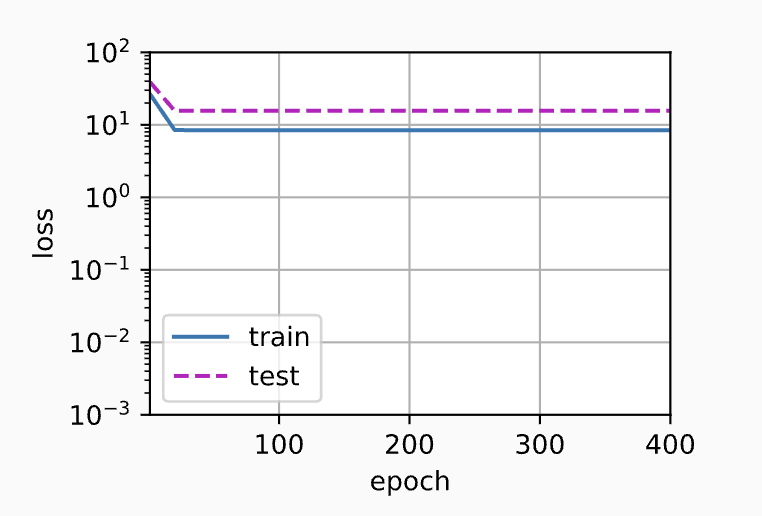
欠拟合 #
# 从多项式特征中选择前2个维度,即1和x
train(poly_features[:n_train, :2], poly_features[n_train:, :2],
      labels[:n_train], labels[n_train:])
- 只给予了前两个特征值 ![[Pasted image 20240704160340.png]]
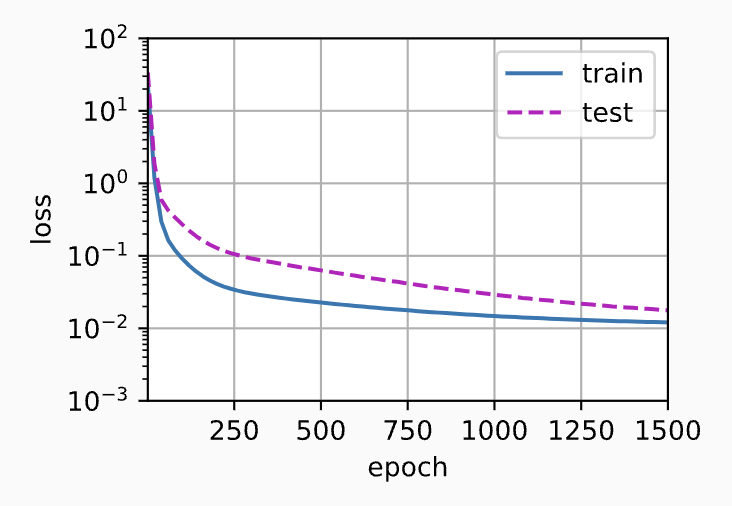
过拟合 #
# 从多项式特征中选取所有维度
train(poly_features[:n_train, :], poly_features[n_train:, :],
      labels[:n_train], labels[n_train:], num_epochs=1500)
- 将w中的20列全部给到了模型导致了过拟合 ![[Pasted image 20240704160346.png]]